

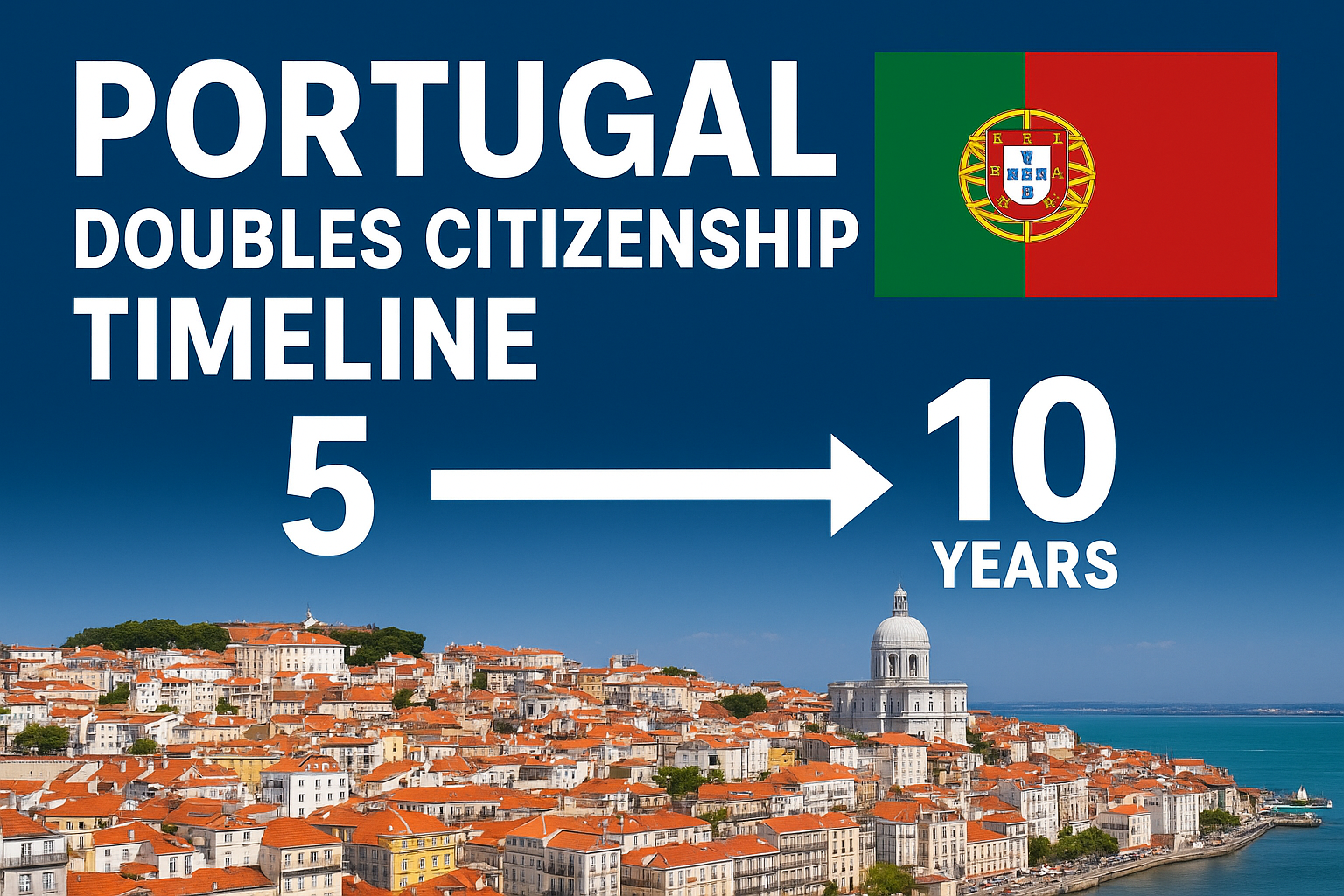
Lisbon | November 2025 — Portugal has approved a sweeping change to its nationality law, doubling the minimum residence requirement for citizenship from five to ten years for most non-EU nationals. For citizens of EU and Portuguese-speaking countries (CPLP), the new threshold will be seven years.
This reform — now awaiting the President’s final signature — redefines how global investors, business owners, and migrant communities plan their long-term presence in Portugal.
⚖️ The Policy Shift: From Investment to Integration
Under the previous framework, foreigners could apply for citizenship after five years of legal residence. The new law makes several crucial changes:
- Residency now counts from the issuance of the residence card, not from the initial application — effectively adding months or even years to the process.
- Cultural and language integration tests will be applied more strictly.
- Those who have already applied under the old five-year rule will be grandfathered in, while new applicants will face the longer timeline.
The official rationale, according to Parliament, is to “strengthen social cohesion and ensure naturalisation reflects genuine integration, not just financial investment.”
💶 Investor & Business Impact: Capital Rerouting and Strategy Shifts
For Asian high-net-worth individuals (HNIs) and entrepreneurs, Portugal’s new law changes the equation.
- Industry estimates suggest 300–500 Indian families, representing €150–250 million in committed capital, may be directly affected.
- Advisors report a 30–40% decline in new applications from India and Singapore since the reform was announced.
- In contrast, interest in the UAE, Greece, and Caribbean residency or citizenship programmes has surged.
For business owners already in Portugal — especially in hospitality, logistics, tech, and manufacturing — the shift underscores the importance of deep local roots rather than short-term investor positioning.
Despite this legal tightening, Portugal remains one of Europe’s most stable and entrepreneur-friendly economies, posting 2.1% GDP growth in 2024, with strong inflows into renewable energy, infrastructure, and digital services.
🌍 The Social Undercurrent: Integration Challenges and Everyday Inequality
Beyond policy, a growing tension is visible in daily life. Many immigrants — particularly from South Asia — report rising discrimination and social friction, even as they fill critical labour shortages.
According to AIMA data, Portugal now hosts over 67,000 Indian residents, making them one of the largest non-EU migrant communities. They contribute across construction, cleaning, agriculture, food, and logistics sectors.
Yet, incidents of petty thefts and grocery shop disputes have increased in some working-class neighbourhoods of Lisbon, Setúbal, and Algarve. Locals and business owners cite a lack of police response and ineffective government oversight, while politicians turn these frustrations into electoral talking points.
Critics argue that the citizenship reform is more political theatre than social progress, creating a narrative of control while ignoring ground realities such as inflation, job insecurity, and everyday safety.
🧭 Migration as Portugal’s Balancing Act
Portugal faces a structural paradox:
- Its youth and skilled professionals are leaving for better wages in Germany, France, and the UK.
- Simultaneously, immigrants sustain the country’s economy, working in essential but underappreciated sectors.
Immigrants are not outsiders — they are contributors to national development, paying taxes, filling labour gaps, and keeping Portuguese industries competitive.
Migration, therefore, is not a burden; it is a balancing act — stabilising a shrinking workforce and enriching Portugal’s cultural and economic landscape.
🏁 Conclusion: Building a Shared Future
Portugal’s new citizenship timeline signals a decisive policy shift — from speed to substance. While it may discourage short-term investors, it rewards long-term engagement, cultural participation, and social contribution.
For international investors and business owners from Asia, the message is clear:
Success in Portugal will now depend less on capital — and more on commitment.
Portugal’s youth may seek opportunity abroad, but its progress at home is powered daily by the energy, ambition, and resilience of immigrants.
If managed with fairness and foresight, migration will continue to be Portugal’s greatest strength — not its political scapegoat.
What’s your take?
Do you think Portugal’s new citizenship rules will strengthen integration — or discourage global talent and investment?
👇 Let’s discuss in the comments. OR Write us docuruniversal@gmail.com
Leave a Reply